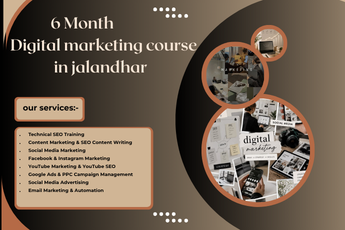
Course Overview: 6-Month Digital Marketing Training in Jalandhar After 12th
There is hardly any other sector which is experiencing so much growth in terms of careers like digital marketing. As organizations today rely heavily on online marketing in order to connect with customers and market their products/services, generate leads and make brands strong, learning digital marketing skills becomes highly relevant for those who have passed 12th standard and wish to take their career in this direction.
Students enrolled in this program get introduced to all major domains of digital marketing such as Search Engine Optimization (SEO), social media marketing, Google Ads, content marketing, email marketing, website analytics, online reputation management, and digital advertising. Along with learning theoretical concepts, they also have the opportunity to practice through assignments, campaigns, and projects related to digital marketing.
Begin Your Career in Digital Marketing after 12th
Having completed 12th standard, it marks an important milestone in students' life when they think of higher studies and career paths they need to follow. Though conventional programs play their role in shaping careers, skill-based programs can play equally important role in building specialized knowledge base for students.
A 6-months course in digital marketing after 12th grade can suit different streams. No matter whether a student has pursued commerce, arts, science or some other stream of education, it is possible to learn digital marketing having only basic computer knowledge and communication skills.
In addition, the sphere is varied. Students do not have to specialize in anything at once. They will be able to try SEO, social media marketing, advertising, content marketing, analytics, and other fields during their training and only then choose their specialization.
Course modules
A well-composed training course lasts for 6 months and includes several modules to give students a full overview of the online marketing field.
Module
1. Introduction to Digital Marketing
The training starts with basics of digital marketing. Students study how companies use digital channels to communicate with their audience and to advertise their products or services.
- Some of the topics that are covered here may be:
- Definition and importance of digital marketing
- Digital marketing vs traditional marketing
- Online behavior of customers
- Digital marketing channels
- Marketing funnels
- Customer journeys
- Strategies of digital marketing
- Introduction to online branding
2. Web Site Essentials
A web site is a vital element of many digital marketing campaigns. Students gain knowledge of some fundamental ideas about web sites and understand how web sites contribute to marketing efforts.
Topics may include:
- Web site architecture
- Concepts related to domain name and hosting
- Landing pages
- Web site navigation
- User experience
- Mobile web sites
- Web site optimization
- Basic web site content management
Students can learn about problems with web sites that might have an adverse effect on user experience and marketing results.
3. Search Engine Optimization (SEO)
SEO is perhaps the most important module in the area of digital marketing. Students learn how web sites can become more visible in search engines through optimization.
The SEO module may include:
- Keyword research
- Long-tail keywords
- On-page SEO
- Off-page SEO
- Technical SEO
- Content optimization
- Internal linking
- Link building
- Local SEO
- Competitor analysis
- SEO audit
- Search engine algorithms
Students can perform keyword research and optimize sample web pages to understand how SEO works in practice.
4. Content Marketing
This module teaches how to develop marketing content according to the needs of the target audience.
Possible topics:
- Content strategy
- Blog writing
- SEO content writing
- Website content
- Social media content
- Content planning
- Headlines and titles
- Keywords placement
- Content optimization
- Content calendar
Students can also learn how to produce informative content in order to meet SEO and branding goals.
5. Social Media Marketing
Social media platforms have turned into powerful marketing tools for companies. The module teaches how companies can utilize social media to increase brand awareness and get engaged with target audiences and generate leads.
Possible topics:
- Social media strategy
- Facebook marketing
- Instagram marketing
- LinkedIn marketing
- YouTube marketing
- Social media content planning
- Hashtag research
- Audience engagement
- Social media analytics
- Brand promotion
Practical activities will teach students how to manage social media campaigns.
6. Google Ads and PPC Advertising
With paid marketing techniques, businesses can target audiences through search engines and online platforms. Students learn basics of Pay-Per-Click (PPC) advertising.
These topics could include:
- Google Adwords basics
- Campaigns in search engine
- Display ads
- Keyword selection
- Writing ad copy
- Targeted audience
- Budget planning
- Concepts of bidding
- Tracking conversions
- Campaign optimization
Also, students will know how to assess the performance of their campaigns through crucial advertising metrics.
7. Social Media Advertising
Paid advertisements can help in organic social media marketing efforts. Students learn how companies use social media advertising in order to target certain audiences.
These topics could include:
- Campaign goals
- Targeting of an audience
- Advertising formats
- Creating advertisement
- Budget management
- Campaign monitoring
- Concepts of retargeting
- Campaign performance analysis
This allows students to distinguish between organic and paid social media efforts.
8. Email Marketing
Email marketing continues to be a powerful tool in customer communication, lead generation, promotions, and retention. Students learn how to conduct structured email campaigns.
These topics could include:
- Basics of email marketing
- Email list management
- Newsletter development
- Email content
- Planning of campaigns
- Email automation
- Opening rate
- Click rate
- Analysis of email campaign performance
9. Web Analytics
More and more decisions in digital marketing rely on data. Students learn how analytics tools help marketers analyze website visitors and campaign performance.
Analytics Module Can Provide:
- Website traffic analytics
- User behavior
- Traffic sources
- Conversions tracking
- Campaign analytics
- KPIs
- Reporting & Dashboards
- Marketing data driven
Learning the basics of analytics will give the opportunity to students not just to develop campaigns but also to learn how to analyze their effectiveness.
10. Online Reputation Management
Reputation of a company on the internet can be a factor in building customers' trust and making their decisions. Students can learn simple techniques of monitoring and improving companies' online reputation.
Can Include:
- Online Reviews
- Mentions of the brand
- Customer feedback
- Monitoring reputation
- Reviews management
- Addressing customer issues
- Improving online reputation
11. E-Commerce Marketing
Development of online commerce led to the increasing demand for digital marketing skills in this area. This module can teach students how digital marketing can be used in e-commerce.
Topics May Include:
- SEO for e-commerce
- Optimization of product pages
- Product keyword research
- Online advertising
- Social media marketing
- Conversion optimization
- Customer retention
- Remarketing
12. AI in Digital Marketing
Nowadays, many marketing professionals are incorporating artificial intelligence in their efforts to enhance efficiency and make better decisions. The application of AI in digital marketing can be covered in the class.
Topics may include:
- Content creation with AI support
- Keyword research
- Customer personalization
- Chatbots
- Marketing automation
- Data analysis
- Campaign ideas powered by AI
- Generative AI
The key point is to use AI properly and combine human skills of creativity, precision, and strategy.
Practical Training and Projects
Among the advantages of 6-month long digital marketing courses there is practical knowledge. Students can do different assignments and projects that help them use all the concepts they learn from the training.
Practical work may include:
- Keyword research projects
- SEO website audit
- Blogging
- Social media calendar creation
- Planning Google Ads campaigns
- Working with social media ads
- Email campaigns creation
- Analyzing data and writing reports
- Competitor research
Digital marketing strategy creation
Why Opt for 6 Months’ Digital Marketing Training Program after Class 12?
1. Development of Skills for Career Purpose
Digital marketing allows the learners to acquire certain skills which can be used in various businesses.
2. Appropriate for Various Streams
There is no particular requirement for having a certain academic stream in order to start learning digital marketing.
3. Numerous Job Profiles
On the completion of learning process and gaining necessary experience, one can have the following profiles:
- SEO Executive
- Digital Marketing Executive
- Social Media Executive
- PPC Executive
- Content Marketing Executive
- SEO Analyst
- Social Media Manager
- Digital Advertising Executive
- Email Marketing Executive
- Performance Marketing Executive
Job prospects and requirements can depend on skills, experience, quality of portfolio, etc.
4. Practical Approach towards Marketing Concepts
Apart from just learning the theory part, one can get practical experience of assignments/campaigns similar to that done in business organizations.
5. Building a Portfolio
Projects done as a part of training can be included in the student's portfolio. Such a portfolio can help in showcasing practical skills while applying for internships, entry-level job positions, or as freelance.
6. Understanding of Current Digital Marketing Trends
Trends in digital marketing keep changing. Training programs can familiarize students with new trends such as artificial intelligence, automation, data analysis, influencer marketing, and performance marketing.
7. Scope of Freelancing
Skills of digital marketing can also be used in freelance work. Strong skills of digital marketing allow students to provide freelance services such as SEO, content writing, social media management, and advertising.
8. A Basis for Further Education
It is possible that a 6-month course is not the final stage of education of the students. It can serve as the base for higher-level certifications and specializations, internships, and education.
Who Can Attend This Course?
A 6-month digital marketing training program can be beneficial for:
- Students who have finished 12th
- College-going students
- Digital marketing beginners
- Entrepreneurs
- Business owners
- Freelancers
Acquisition of basic knowledge about computers, readiness to learn, creativity, communication skills, and analysis may also assist students in progressing faster in the class.
Learning Approach
A good digital marketing course should include theoretical lectures, demonstration of marketing activities, practice, project-based approach, and performance analysis. It is important to let the students experiment with various marketing approaches and to know both success and failures of marketing campaigns.
Assignments will help to develop theoretical knowledge, and project-based approach will give the experience of implementing the entire marketing process, including research and planning
Certification and Portfolio Creation
In case of successful completion of the training, students will be able to get a completion certificate, depending on the certification process of the institution. This certificate may be put in a resume or on a professional profile as an indicator of training completion.
However, this certification is just a part of career advancement process. Practice, portfolio, communication skills, industry knowledge, and learning process are also critical for digital marketing career.
Scope of Career in Digital Marketing after Training
As digital economy opens up new avenues for companies to engage their customers through websites, search engine optimization, social media, email marketing, videos, and advertisements, a student who is well versed with the training in digital marketing can find career prospects in various sectors like ecommerce, education, health care, hospitality, tech sector, retailing, real estate, and professional services.
The student may start off by taking up entry-level jobs and later specialize in various aspects of digital marketing, such as SEO, PPC, social media marketing, digital marketing analytics, content marketing, and performance marketing. Experienced people can move towards higher job profiles like marketing strategist, campaign manager, and consultant.
Conclusion
6-Month Digital Marketing Training in Jalandhar After 12th can serve as a practical way for students who would like to acquire career-oriented digital competencies at an early stage. This training will introduce important areas, including SEO, social media marketing, Google Ads, content marketing, email marketing, analytics, e-commerce marketing, online reputation management, and artificial intelligence in digital marketing.
It will be possible for students to understand how contemporary businesses manage to reach and communicate with their customers using digital channels due to the combination of theory and practice. Moreover, it will be helpful for students to build a portfolio, find opportunities for internships and job opportunities, and realize their specialization area.
For those students who have finished 12th and are interested in technology, creativity, communication, business, and online platforms, digital marketing can become a versatile field for continuous learning and career development.
Why Select TechCadd for the 6-Month Digital Marketing Course at Jalandhar?
Selecting the correct institution is an essential aspect for the students who are going to start their career in digital marketing after class 12th. Digital marketing is a practical subject, which constantly changes and evolves, and thus it needs more than theoretical knowledge. For instance, students need to know the basics of the search engines, social networks, paid advertising, content creation, analytics, website management, and new technologies like artificial intelligence. The special program will allow developing those skills gradually.
TechCadd provides a professional environment for those students who plan to pursue their career in digital marketing. Its course program can enable learners to gain the basics before they start mastering the advanced digital marketing skills. The program is based on the most relevant aspects of online marketing and thus provides students with the opportunity to practice what they have learned through assignments and projects.
1. Broad Curriculum of Digital Marketing
The first reason to select TechCadd is its comprehensive digital marketing curriculum. Unlike other institutions where learners study just one marketing channel, TechCadd teaches all the areas of digital marketing.
Topics covered in the curriculum could include:
- Digital Marketing Basics
- Website Basics
- Search Engine Optimization
- Keyword Research
- Content Marketing
- Social Media Marketing
- Google Ads and PPC
- Social Media Advertising
- Email Marketing
- Web Analytics
- E-Commerce Marketing
- Reputation Management
- Affiliate Marketing
- Conversion Rate Optimization
- Digital Marketing Strategy
- AI in Digital Marketing
Such wide-ranging curriculum can help the students gain an understanding of the role of various channels in digital marketing towards their contribution towards the growth of the business.
2. Strong Foundation of Digital Marketing Knowledge
Since the students will have limited knowledge on the subject of professional marketing after completing their 12th, it will be good to begin with basics.
The TechCadd course could enable the students to start off from the basic concepts in digital marketing. The students could gain knowledge about online customers, digital marketing channels, marketing funnel, brand awareness, lead generation, conversions, and customer engagement.
3. SEO Training
Here are several aspects of SEO that can be covered within the training program:
- Keyword research
- Long-tail keywords
- On-page SEO
- Off-page SEO
- Technical SEO
- Local SEO
- Competitor analysis
- Content optimization
- Internal linking
- Link building basics
- SEO audits
Students may learn about the benefits that organic visibility through search-friendly content and SEO optimized websites provides.
4. Keyword Research
Keyword research is a critical element of SEO and content marketing. Students can acquire skills of identifying relevant keywords that meet the search intent and goals of the company.
Here are some aspects that can be included in the learning process:
- Short-tail keywords
- Long-tail keywords
- Search intent
- Keyword competition
- Keyword relevance
- Competitor keyword research
- Keyword placement
Acquiring knowledge on keyword research can help students develop effective SEO and content strategies.
5. Social Media Marketing Course
Social media platforms have become an effective way of communication for brands. TechCadd's course on digital marketing can offer students an insight into social media marketing and how organizations utilize social media platforms for generating awareness and engagement.
These topics include:
- Social media strategy
- Content strategy
- Facebook marketing
- Instagram marketing
- LinkedIn marketing
- YouTube marketing
- Engagement
- Hashtag research
- Analytics
- Branding
Thus, students can be acquainted with the creative and strategic aspects of social media marketing.
6. Google Ads and PPC Training
The aspect of paid advertising is also a significant component of digital marketing. The students can learn how the process of search advertisement works and how companies conduct their paid advertisements to target their audience.
Topics that can be included in the curriculum are:
- PPC basics
- Google Ads
- Search ads
- Display ads
- Keyword selection
- Ad copy
- Audience targeting
- Bidding
- Budgeting
- Conversion
- Optimization
7. Content Marketing and SEO Writing
Content is central to most digital marketing campaigns. Companies require blog articles, website pages, social media updates, product descriptions, emails, and other types of digital communications.
Students can learn about:
- Content strategy
- Blogging
- SEO writing
- Website copywriting
- Social media writing
- Headlines and titles
- Content calendars
- Content optimization
- Audience-oriented writing
This particular module can prove useful for those students who enjoy writing and creative activities.
8. Website and Landing Pages
A professional in digital marketing must understand how websites work for marketing campaigns. The program offered by TechCadd can teach students about websites structure, landing pages, navigation, user experience, and basics of optimization.
Students can learn about the use of landing pages for:
- Lead generation
- Promotion of products
- Advertising campaigns
- Newsletter subscription
- Services inquiry
- Conversion
This information will help students understand the connection between advertising, website traffic, and conversion.
9. Digital Marketing Analytics
In modern times digital marketing cannot exist without analytics. Marketers have to understand whether their campaigns generate traffic, engagement, leads, or sales.
Analytics training will acquaint students with:
- Website traffic
- Traffic sources
- User behavior
- Campaign performance
- Conversion tracking
- Key performance indicators
- Reporting
- Data interpretation
Analytics will enable the students to base their marketing decisions on measurable results as opposed to assumptions.
10. E-Commerce Digital Marketing
The popularity of online shopping has increased the demand for digital marketing skills within e-commerce. The marketing strategies' application in the online store can be learned.
The course can cover:
- E-commerce SEO
- Product page optimization
- Product keywords
- Online ads
- Social media marketing
- Remarketing
- Conversion optimization
- Customer retention
It can be useful for those interested in working with online companies.
11. AI in Digital Marketing
Artificial intelligence is changing marketing through research, campaign creation, analysis, and personalization. Therefore, an updated curriculum should provide students with knowledge of the AI usage in digital marketing.
They can learn about:
- AI-powered content creation
- Research
- Assistance in keywords finding
- Customer personalization
- Chatbots
- Automation of marketing campaigns
- Analysis of data
- Campaign ideas
- Generative AI
The goal is not just using AI-powered tools but knowing how they can aid human thinking.
12. Focus on Industry-Relevant Learning
Digital marketing is a practical field where theoretical knowledge alone may not be enough. TechCadd's training approach can help students understand how digital marketing concepts are applied in real business situations. Learning through practical assignments, campaign exercises, website-related activities, and marketing projects can help students connect classroom concepts with professional requirements.
13.. Learn Multiple Digital Marketing Channels
Another advantage of a comprehensive course is exposure to different digital marketing channels. Students can learn how SEO, social media, paid advertising, content marketing, email marketing, and analytics work together. This broader understanding can help beginners identify their strengths and choose an area for future specialization.
14. Develop Analytical and Creative Skills
Digital marketing requires a combination of creativity and analytical thinking. Creating attractive content, developing campaign ideas, and planning social media posts requires creativity, while keyword research, campaign reporting, website traffic analysis, and conversion tracking require analytical skills. A balanced curriculum can help students develop both skill sets.
15. Understand Customer Behavior
Successful marketing begins with understanding customers. During digital marketing training, students can learn about target audiences, search intent, customer journeys, engagement, and conversion behavior. These concepts can help learners understand why customers interact with particular content, advertisements, websites, and social media campaigns.
16. Build Confidence Through Projects
Practical projects can play an important role in building confidence. Instead of simply studying concepts, students can apply their knowledge by creating SEO strategies, content plans, social media campaigns, advertising proposals, and analytics reports. Completing these activities can make learners more comfortable with digital marketing tasks.
17. Learn About Modern Marketing Trends
The digital marketing industry continues to evolve with technologies such as artificial intelligence, automation, short-form video, personalization, and advanced analytics. A modern curriculum can introduce students to these developments and help them understand how new technologies are influencing marketing strategies.
18. Preparation for Professional Opportunities
Digital marketing training can help students understand the skills expected in entry-level marketing roles. Along with technical knowledge, students can develop skills such as communication, research, presentation, problem-solving, reporting, and campaign planning. These skills can be useful when preparing for internships, jobs, or freelance opportunities.
19. Opportunity to Build a Digital Marketing Portfolio
A portfolio can be an important part of a beginner's professional profile. Students can organize their assignments and projects into a portfolio that demonstrates their practical abilities. Examples may include SEO audits, keyword research, content samples, social media calendars, campaign plans, and analytics reports.
20. Foundation for Long-Term Career Growth
A 6-month course should be viewed as the beginning of a professional journey rather than the final stage of learning. After completing training, students can continue developing specialized skills in SEO, PPC, social media, analytics, e-commerce, content marketing, or performance marketing. This continuous learning approach can support long-term career development.
Conclusion
The selection of an appropriate institute makes a huge difference in case of embarking on a career in digital marketing. The 6 months' digital marketing training course offered by TechCadd in Jalandhar could cover a wide range of topics like SEO, social media, PPC, content marketing, analytics, e-commerce, artificial intelligence and many more topics related to online marketing.
The course could be considered as a good practical starter for those students who have completed their 12th. The learning of the basic concepts and the advanced concepts of digital marketing, the assignments and projects as well as the building of the portfolio by the learners can give them valuable experience in digital marketing.
However, most importantly, the students must take the course as a starting point in their professional learning. It is worth noting that the digital marketing area requires the ability to constantly learn, experiment, think analytically and creatively, as well as adapt.
Future Scope of a 6-Month Digital Marketing Course in Jalandhar After 12th
In recent years, digital marketing has gained importance among businesses since many companies now rely on websites, search engines, social media, online advertisements, email, and other digital platforms to reach out to customers. This increased reliance on online marketing has created various employment opportunities for those skilled in digital marketing.
A 6-Month Digital Marketing Course in Jalandhar after 12th would provide practical knowledge and skills related to the different aspects of online marketing to interested individuals. Moreover, digital marketing requires skills from several disciplines such as creativity, technology, communication, business, and data analytics.
1. Rising Demand for Digital Marketing Professionals
Most businesses require an online presence to advertise their products and services. From small businesses to startups and even from e-commerce businesses to big companies, most firms use digital platforms to attract customers and create leads.
As more companies take interest in digital marketing practices, there will always be a demand for skilled personnel who can manage those tasks. Students who have information about SEO, social media, paid advertising, content marketing, analytics, and all other digital marketing techniques will find many openings in various industries.
Some of the future trends that will impact digital marketing include the use of artificial intelligence, automation, personalization, video marketing, and data-based decision making. Professionals who constantly update their knowledge and skills will always be ready for any developments in the field.
2. Career Options After Digital Marketing Training
Probably the most important thing about taking up digital marketing as an education is the wide range of career options. Students do not need to limit themselves to one particular job role.
Once they develop the appropriate set of skills and gain some experience, they may consider the following career options:
- Digital Marketing Executive
- SEO Executive
- SEO Analyst
- Social Media Executive
- Social Media Manager
- PPC Executive
- Google Ads Specialist
- Content Marketing Executive
- Email Marketing Executive
- Digital Advertising Executive
- Performance Marketing Executive
- E-commerce Marketing Executive
- Digital Marketing Analyst
- Content Strategist
- Affiliate Marketing Executive
3. Career Option as a Digital Marketing Executive
The Digital Marketing Executive is one of the common choices for the beginner in this field.
Experts can also assist in report creation, campaign monitoring, competitor analysis, and coordination of marketing activities.
For newbies, this career choice provides experience in many aspects of digital marketing prior to making a decision about specializing in SEO, paid ads, social media, analytics, or any other field.
4. Career as an SEO professional
The Search Engine Optimization is another important career choice. The SEO experts help companies increase their visibility on the internet through such means as keywords research, website optimization, technical improvements, internal link building, and off-page SEO.
The students who like researching, writing, websites, and analytics can consider SEO specialization as interesting for them.
SEO career opportunities include:
- SEO Executive
- SEO Analyst
- SEO Specialist
- Technical SEO Executive
- Local SEO Specialist
Due to the competition in the online sphere, SEO can continue being an essential part of the digital marketing strategy.
5. Career in Social Media Marketing
With the increasing significance of social media as channels for building brands, communicating, and engaging with customers, social media marketers plan and design their content, manage brand pages, analyze engagement levels, organize campaigns, and engage with their social media followers.
Creative and communicative students may look at opportunities in:
Social Media Marketing
Social Media Management
Community Management
Social Media Strategy
Social Media Advertising
Increasing significance of video, collaboration with creators, and social commerce is opening up new options in this field.
6. Career in Google Ads and PPC
Paid search ads provide businesses with the opportunity to connect with their audience when they are actively looking for their product or service. PPC professionals plan and organize advertising campaigns, keeping track of budgets, keyword lists, audiences, conversions, and campaign performance.
Some options in this career stream include:
- PPC Executive
- Google Ads Executive
- Paid Media Executive
- Performance Marketing Executive
Professionals skilled at analysis and campaign optimizations may move on to performance marketing careers.
7. Career in Content Marketing
Content marketing involves creation of useful and relevant content that helps in attracting and engaging the audience. Examples of content include blogs, web pages, video, social media content, email newsletters, guides, and product content.
Students who excel at writing and creative work may look into these careers:
Content Writer
SEO Content Writer
Content Marketing Executive
Content Strategist
Copywriter
While the use of AI technology is making changes to content creation process, human creativity, fact-checking, strategy formulation, brand identity and editorial sense remains an essential part of the job.
8. Career in Performance Marketing
Performance marketing revolves around measurable achievements such as generating leads, making sales, converting leads to sales, customer acquisition.
People working in this area may deal with:
Paid Search
Social Media Advertising
Remarketing
Conversion Tracking
Campaign Analytics
Landing Pages
Performance Reporting
Students who have interest in figures, advertising and business results may consider specialization in performance marketing.
9. E-Commerce Marketing Opportunities
With the rise of online shopping, the role of digital marketing in e-commerce business has become more relevant than ever before. Digital marketers will be required for driving traffic, optimizing product pages, managing advertisement campaigns, and increasing conversions.
Opportunities may include the following jobs:
E-commerce Marketing Executive
E-commerce SEO Executive
Product Marketing Executive
Performance Marketing Executive
E-commerce Content Specialist
It is possible to apply the concepts learned about digital marketing to platforms, independent websites, and direct-to-consumer brands.
10. Opportunities in Freelancing
Finally, digital marketing may also open the way for freelancing opportunities. Professionals can provide their services to their clients on a freelance basis.
Freelance may involve the provision of the following services:
SEO
Social media management
Content writing
Website optimization
Google Ads management
Social media advertising
Email marketing
Digital marketing consultation
However, to be successful, freelancers should possess practical skills, be able to communicate, develop a portfolio, manage clients, and perform consistently.
11. Entrepreneurship and Business Opportunities
In addition to finding work in digital marketing, digital marketing skills can help students become entrepreneurs. For instance, an entrepreneur can leverage digital technologies to create brand awareness, reach out to clients, create leads, and promote his/her products or services.
Thus, a student might create:
A digital marketing agency
SEO service
Social media management service
Content marketing service
Online advertising consultancy
E-commerce business
Consequently, knowledge about digital marketing can help a student become a successful entrepreneur in addition to providing employment opportunities.
12. AI and the Future of Digital Marketing
Another technology that is crucial for the future development of digital marketing is artificial intelligence. In particular, AI can help marketers with ideas generation, data analysis, customer segmentation, personalization, automation, and campaign optimization.
Thus, in the future, digital marketers will work together with AI tools rather than consider it an independent technology.
Therefore, it is important for students to develop skills in:
Content creation with AI assistance
Prompting and research
Marketing automation
Personalization
Data analysis
Keyword research using AI
Chatbots
Predictive marketing
While AI will become an integral part of digital marketing in the future, some skills will not lose their importance.
13. Increase in Marketing Analytics
Data-driven marketing is another area that is relevant for the future of the industry. Companies need to know what sources bring them clients, what campaigns lead to conversions, how the money is spent on marketing, etc.
Knowledge of marketing analytics will give digital marketers an advantage since they will be able to tie actions in marketing with results.
Key fields include:
Website analytics
Conversion tracking
Campaign reporting
Customer behavior
Marketing KPIs
Data interpretation
Performance dashboards
Students with combined knowledge of digital marketing and analytics will have the opportunity to become experts in marketing analytics and performance marketing.
14. Increase in Local Digital Marketing
Many local companies use digital tools to target customers in specific geographical areas. Restaurant owners, schools, healthcare facilities, retail stores, service providers and other local companies can benefit from local SEO, social media, online reviews, location-based advertising and other local digital marketing techniques.
The following skills may become helpful for professionals:
Local SEO
Google Business Profile optimization
Local keyword research
Online reviews
Location-based advertising
Local content marketing
For Jalandhar-based students, this knowledge can be especially useful since many companies will work in the vicinity of the city.
15. Growing Importance of Video Marketing
The video format has become an integral part of digital communication. Businesses utilize videos for product presentations, training, advertising, education, testimonials, and social media marketing campaigns.
Future professionals in digital marketing could find useful the following topics:
YouTube marketing
Video SEO
Short-form video
Video advertising
Social media video
Video content marketing
The combination of marketing and basic video production and editing will expand the employment options of students.
16. Importance of Continuous Skill Development
Digital marketing is a dynamically evolving field. The algorithms of search engines, advertising tools, social media trends, consumer behavior, artificial intelligence, and analytics solutions may change over time.
Thus, the completion of a 6-month course should be seen as a starting point rather than the end of studying.
Skills development should proceed through:
Industry updates
Certifications
Projects
Courses
Experiments
Professional networking
Portfolio creation
The continuous process of learning could make professionals competitive in the dynamically changing market.
17. Career Growth and Specialization
There is room for career growth from a generic job to specialized or managerial jobs in digital marketing.
One can begin their career as a Digital Marketing Executive, and then go on to get specialized in SEO, PPC, Social Media, Content, Analytics, or Performance Marketing. Professionals may grow up the ladder to become professionals such as:
Digital Marketing Specialist
SEO Manager
PPC Manager
Social Media Manager
Performance Marketing Manager
Digital Marketing Manager
Marketing Strategist
Digital Marketing Consultant
All of this will depend upon the professional’s experience, skills, results, and ability to lead, among other things.
18. Scope Across Different Industries
Digital marketing is not limited to any one industry.
E-commerce
Education
Healthcare
Real Estate
Hospitality
Retail
Technology
Finance
Travel
Manufacturing
Professional Services
Media and Entertainment
This wide scope across different industries makes digital marketing a versatile profession.
19. Scope for Students After 12th
For those students who have passed the 12th grade, digital marketing presents an option to begin their professional development right away.
This discipline can be especially relevant for students who want to combine studies in business, creativity, communication, technology, and analytics.
A 6-month course will allow students to get to know more about the field and to choose a specialization of their choice. Further, they can engage in internships, pursue further studies, take advanced courses, become a freelancer or look for employment.
20. The Importance of a Good Portfolio
A good portfolio is very important in the sphere of digital marketing. Therefore, students have to pay special attention to creating their portfolio.
Their portfolio can include:
SEO audit
Keywords analysis report
Blog posts
Social media campaign
Advertising campaign
Website optimization
Analytics report
Content calendar
Digital marketing strategy
A good portfolio will help to showcase their skills to future employers and clients.
Conclusion
The future scope of digital marketing after 12th is vast as companies continue to depend on digital marketing to acquire customers, communicate, build their brand, and sell their products or services. A 6-month Digital Marketing Course in Jalandhar will give students knowledge about SEO, Social Media Marketing, PPC, Content Marketing, Analytics, E-commerce, Artificial Intelligence, and many more areas.
There are various career opportunities for a student in the form of digital marketing executive, SEO executive, social media manager, PPC executive, content marketer, performance marketer, and e-commerce marketing professional.
The future of digital marketing is expected to be highly impacted by artificial intelligence, automation, data analysis, personalization, video marketing, and performance marketing. Students need to focus on acquiring these emerging skills along with their creativity, communication skills, analytical skills, and learning.